Small Business Taxes

taxes for small businessFor those of us who run a small business almost nothing causes more challenges and stress than tax time.

Today’s post is meant for those of you running, or thinking about running, a small business, and how you can make tax-time easier.

I want to establish up-front that I am not a tax accountant or tax lawyer, nor do I play one on TV.

My wife and I do, however, run three home-based businesses and I have filed my own taxes for years. My wife runs a business called Hair Springs and I have an insurance business and maintain and host a few websites for some friends.

The key to doing your taxes is to KEEP GOOD RECORDS!

What should I do in order to maintain good records?

There are four steps to maintaining good records in order to make tax time easier.

Step One: Open a checking account that you only use for your business. Get checks and a debit card.

Step Two: Download business accounting software. For a long time, QuickBooks was the only player in this market, and for years they offered a free version for those running home-based businesses. This ended a few years ago, though, and the cheapest version is now $10 a month. QuickBooks holds over 90% of the market, and is a great choice for many businesses.

If you have less than 9 employees, though, you should check out WAVE, which is free. You can find it here: https://www.waveapps.com/accounting/.

Step Three: Make all purchases and pay all expenses with your business account, and make all deposits from sales into this account.

Step Four: Get a receipt for EVERYTHING, and anytime you make a sale print up a receipt. Enter all sales and expenses into your accounting software.

If you plan to use a professional tax preparer, that is pretty much all you need to do. This person can handle all the accounting details for your company and they will file your return and other taxes for you.

The IRS has a post that discusses in detail what type of records you should keep. You can find that here: https://www.irs.gov/Businesses/Small-Businesses-&-Self-Employed/What-kind-of-records-should-I-keep

How do I figure out how much I need to pay in taxes?

Most home-based businesses will file an annual tax return and you will do so with your regular tax return. Your business income and expenses will be entered on Schedule C, then your profit or loss is  transferred to Form 1040.

You are going to either have a business loss or profit. If you have a profit (which is the point of having a business) you are going to pay self-employment tax of 15.3% plus income tax. To figure out if you have a profit or loss you deduct all business expenses from your business income. If the number is still positive, you have a profit. If the number is negative, you have a loss.

A profit gets added to your income and a loss can actually lower your income, meaning that you will owe less in taxes.

NOTE: The IRS understands that you may have a loss for a year or two when starting up, and occasionally you may have a bad year. The point of having a business, though, is to make a profit. If you don’t make a profit at least 3 out of every 5 years the IRS will classify your business as a hobby, which means that losses are only deductible up to the amount of profits, and you may have to pay back the taxes you avoided by taking a loss.

15.3% plus income taxes can add up to a big number. Many experts recommend setting aside 25-30% of your income for taxes. I think this is wise advice!

Do I have to pay quarterly taxes?

When you are an employee your employer withholds part of your check and sends it to Uncle Sam. As a self-employed individual, though, no one is withholding anything. The government wants their money regularly, so you may have to pay quarterly taxes.

If you are in your first year running a small business, you don’t need to pay quarterly taxes. After year one, though, you may need to pay quarterly taxes if:

  • You paid more than $1,000 in taxes the previous year
  • You expect to pay more than $1,000 in taxes this year

If you paid no income tax last year you probably don’t need to pay quarterly taxes this year. It still can’t hurt to set some aside for later taxes, though.

A rule of thumb is that is you are going to make more than $15,000 in your business you probably need to pay quarterly taxes. I personally feel that it can’t hurt you to pay quarterly taxes, regardless of how much you are going to make.

To determine how much you should pay, get last year’s tax return and find how much tax you paid (Line 78 of Form 1040). Multiply that amount by .90. If you paid $10,000 in taxes last year you would get $9,000. Divide that number by four ($9,000/4 = $2,250). This is the amount you should pay each quarter.

You pay estimated taxes on Form 1040-ES.

If business slows down (or you do better than expected) you can adjust the amount you are paying.

Quarterly taxes are due April 15, June 15, September 15 and January 15.

As you can see, filing taxes can be quite complex. There are a number of other things to consider as well, such as:

  • What type of business structure to use (sole proprietorship, LLC, etc.)
  • If you are going to keep working full-time or part-time at another job, and how withholding there will affect your business taxes
  • How much of a deduction you can take as a home-office deduction

If you run a very small business you might be able to do this all yourself, but for many people you should strongly consider hiring a tax professional to help you maintain your books throughout the year and file your tax return. Tax professionals understand the tax code and are likely to find deductions you may miss.

You still need to maintain great records, and you should know exactly what your tax professional is doing and why they are doing it. Make sure they take the time to educate you.
Professional tax preparer

Even though I don’t mind filing my own taxes, my business income is getting complicated enough that it’s probably time for me to consider hiring someone to do my taxes for me. A good tax professional is worth their fee.

For additional tax help for your small business, the IRS actually has a helpful page: https://www.irs.gov/Businesses/Small-Businesses-&-Self-Employed/Self-Employed-Individuals-Tax-Center.

To conclude, I want to stress again the vital importance of maintaining good records. Nothing will make tax time more difficult than incomplete or inaccurate records. Set up a separate account, download business accounting software and enter all income and expenses into the software.

Share this:
Facebooktwitterpinterestlinkedinmail

Making tax season a little less taxing

taxesby Ryan H. Law

Politicians love to talk about how long the tax code is and compare it to how long the Bible is. I found quotes of politicians who said it ranged anywhere from 2,500 pages to 1.3 million pages.

It’s actually 13,458 pages (and growing every year), and if you want to order a copy of it you can purchase all twenty volumes of the code and regulations for just $10 for your Kindle device!(1) What a bargain!

In what has to be one of the greatest marketing strategies of all time, the U.S. Government Publishing Office, where you can order a printed copy of the tax code, encourages you to “Cozy up with a book from our latest Catalog,” or in the case of the tax code, cozy up with 20 books. Happy reading!

winter catalog


Here’s answers to common questions to help make tax season, well, a little less taxing.

Q. How early can I file my taxes?

A. Wait to file your taxes until you have ALL your tax forms. This includes W-2s, 1099s, Interest statements, etc. Employers and companies have until February 2 to send you everything, so you should have everything shortly after that. Make a list of what you should receive and wait to start until you have it. The most common forms are:

  • Form W-2: You should receive one from each of your employers

  • Form 1098: If you paid interest on a home or student loan or paid college tuition you will receive a 1098

  • Form 1099-DIV: If you received dividends, distributions or capital gains on any investments, watch for one of these to grace your mailbox

  • Form 1099-INT: Any interest paid to you, such as interest on a CD or bank account, will be reported on this form. If you get a pink one of these, you actually win $1,000(2)

  • 1099-MISC: If you did work as an independent contractor you’ll get one of these.

  • If you donated to a charity they will either provide you a receipt when you donated, or an end of year statement

There’s other forms as well, but those are some of the most common ones.

Here’s a great printable checklist from TurboTax:

http://images.turbotax.intuit.com/iqcms/marketing/lib/TurboTax_TaxPrepChecklist.pdf

Q. Should I file my own taxes or have someone do it for me?

A. There’s a few different ways you can file your taxes:

  • On paper
    I don’t recommend this – calculations can be complicated.

  • Software such as TaxAct, TurboTax or H&R Block at home
    Most of the top-rated software packages are simple and intuitive to use, and they are made for consumers (not accountants). You’ll enter your tax forms in and the software will do the calculations, search for possible errors, and file your taxes electronically. I personally use TaxAct.

  • Discount tax preparation services, such as H&R Block or Jackson-Hewitt
    These companies have their place, but can be expensive for what they provide. Their tax preparers are trained, but use similar software that you can use on your own. If you want the peace of mind from having someone do your taxes, this can be a good option.

  • Volunteer Income Tax Assistance (VITA) or Tax Counseling for the Elderly (TCE)
    VITA and TCE volunteers are IVITA TCERS-certified and will file your taxes for free. You read that correct. It’s free, and there’s no catch. VITA is available for anyone that makes under $54,000, and TCE is available for those over age 60. You can find them here: https://www.irs.gov/Individuals/Free-Tax-Return-Preparation-for-You-by-Volunteers. Both VITA and TCE tend to fill up quickly, and many are first-come, first-served.

  • Accountant or CPA
    Unless you run a business you probably don’t need an accountant or CPA to prepare your return. I have several small businesses, and we still file our own, but if your business starts to grow you should work with your accountant or CPA throughout the year.

Q. What is the due date to file my tax return?

A. It’s normally April 15, but this year it is Monday, April 18. Why? Basically it’s because Washington DC has a holiday (Emancipation Day) on Saturday, April 16, and by law when that holiday falls on Saturday or Sunday it is observed the Friday before. A federal holiday on Friday, April 15 means that tax day gets moved to the following Monday.

To close up this week’s article, I strongly encourage you to check out one of the VITA sites if you make less than $54,000 a year. Most people who uses a discount tax preparer could have their taxes filed for free instead.

One last note – don’t ever get a Tax Refund Anticipation Loan. Companies will offer to give you your tax refund right then, for a fee that ranges between $30 and $150. Don’t fall for it – if you file electronically you’ll have your refund in 1-2 weeks.

(1) http://www.amazon.com/Complete-Internal-Revenue-Federal-Regulations-ebook/dp/B006KS43L8/ref=sr_1_2?ie=UTF8&qid=1453835893&sr=8-2&keywords=irs+code+26

(2) Just kidding.

Share this:
Facebooktwitterpinterestlinkedinmail

What’s up with the economy?

Are you tired of watching your savings earn .02% per year and seeing your investments lose money each year? You’re not alone.

You probably feel a lot like this guy – you just want someone to “FIX IT!”

Let’s establish a few things up front:

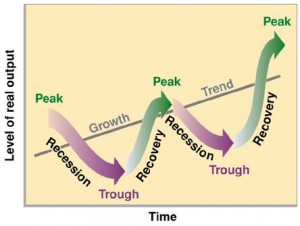
  • The economy moves in cycles:

economy

We go through times of high unemployment, low savings rates, negative stock market growth, etc. and we go through times of low unemployment, great stock market growth, etc.

It’s all part of a cycle.

There are times, of course, when the recessions and troughs last longer than others, but overall that is how the economy works. No one knows how long or short any part of the cycle is going to be.

  • The “stock market” is made up of a lot of different components.
    There are individual company stocks, company and government bonds and money market savings. It also includes things like commodities (gold and silver), oil and real estate. You can invest in all of these.

  • Most people invest in the stock market through their employer (401(k)) or through another retirement account such as an IRA. Typically this is in the form of mutual funds, which is a collection of corporate and government stocks and bonds. Throughout the article when I refer to investing in stocks I am talking about stock mutual funds. Most people shouldn’t be purchasing individual stocks.

  • Past performance in the stock market doesn’t predict what it will do in the future, but it can give you an idea of trends.

So how do you make or lose money in the stock market? When the market is down in a recession or trough stocks generally lose money. This can be caused by many things. Most recently the drop in the market has been caused by economic issues in China and the low price of oil, along with a continuing sluggish economy in the U.S.

In the first two weeks of 2016 the stock market has lost about 8% of its value. 8% in two weeks! Everyone’s invested assets are taking quite a hit right now.

Let’s take a look at some historical data.

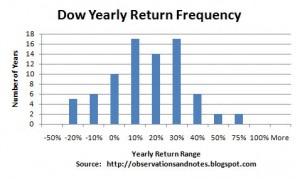
Dow Yearly Return Histogram

The graph above shows the Dow yearly return frequency. You can see that there are years that the return on your investments would have returned more than 70%, and years it would have lost more than 20%. About 25% of the time the market has lost money.

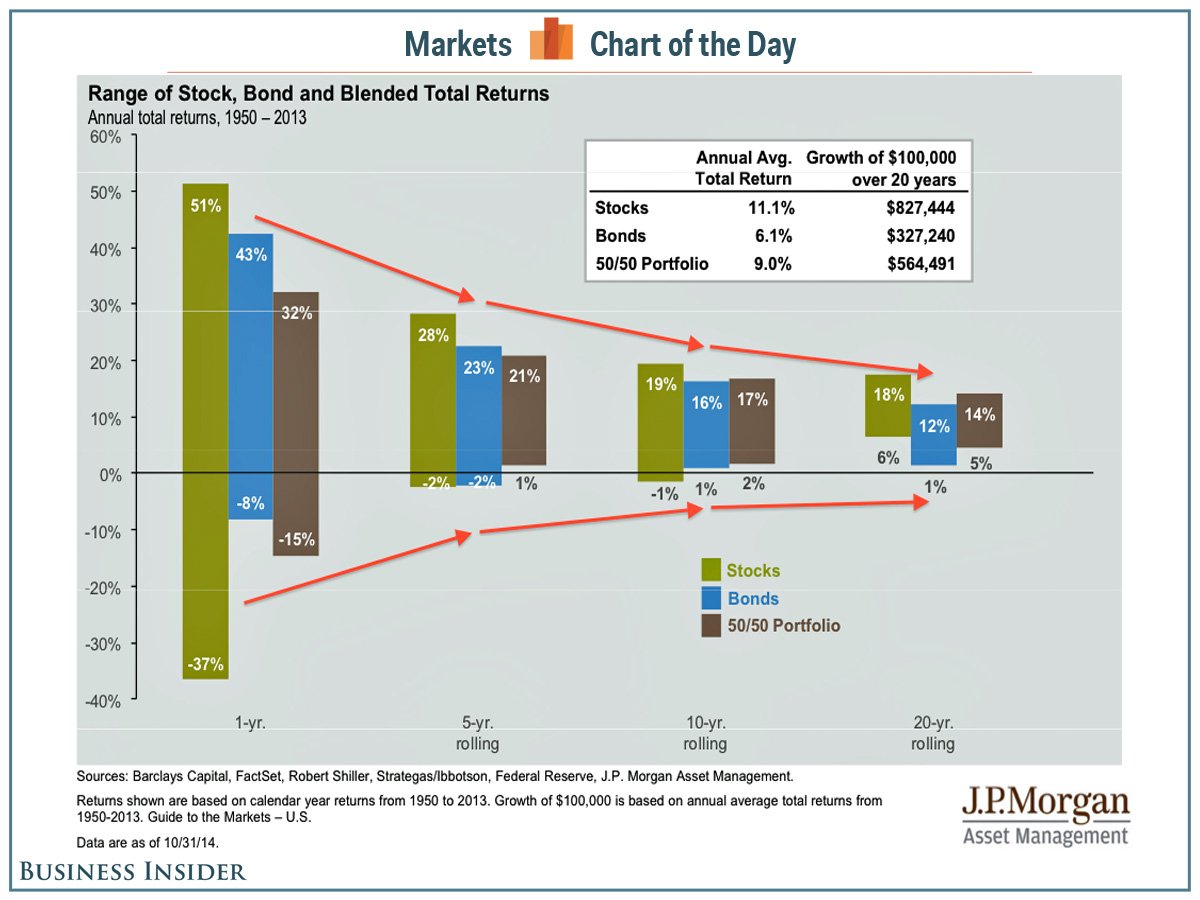
This next graph shows the range of returns for a portfolio of 100% stocks, 100% bonds and 50% stocks and 50% bonds between 1950-2013.

In a single year the stock portfolio returned between -37% and +51%.

If you invested for 5-years that range narrows to -2% and +28%

If you go out to 20 years, the range narrows even more to +6% and +18%.

range of returns

The average annualized returns for stocks during those 20-year periods is 11.1%.

You have to decide if you are willing to ride out the negative years in hopes of gaining in the good years, and how long your time horizon is.

Here are some things to keep in mind:

  • The further out your time horizon is the better chance you have of getting a positive return, with the stock market returning the most. If you don’t have at least 5 years, or even better 10 years, you shouldn’t be invested in stocks.

  • The shorter your time horizon is the more you should be invested in conservative assets such as bonds. That means that you can be invested in stocks the younger you are, and move your money to bonds the closer you get to retirement.

  • A good rule of thumb is that you should take 100 minus your age and that’s how much you should invest in stocks. If you are 40 years old you should invest about 60% in stocks (100 – 40 = 60%). If you are 55 years old you should invest about 45% of your money in stocks. Your risk tolerance level might be higher or lower than that, though. Here is a good free online tool that will help you determine your risk tolerance level: http://njaes.rutgers.edu:8080/money/riskquiz/. Because I have a higher risk tolerance I have more of my assets invested in stock mutual funds.

  • Remember that there are additional ways to invest your money. While most of our retirement money is in the stock market, we are saving up money to invest in some real estate as well. A diversified portfolio is best.

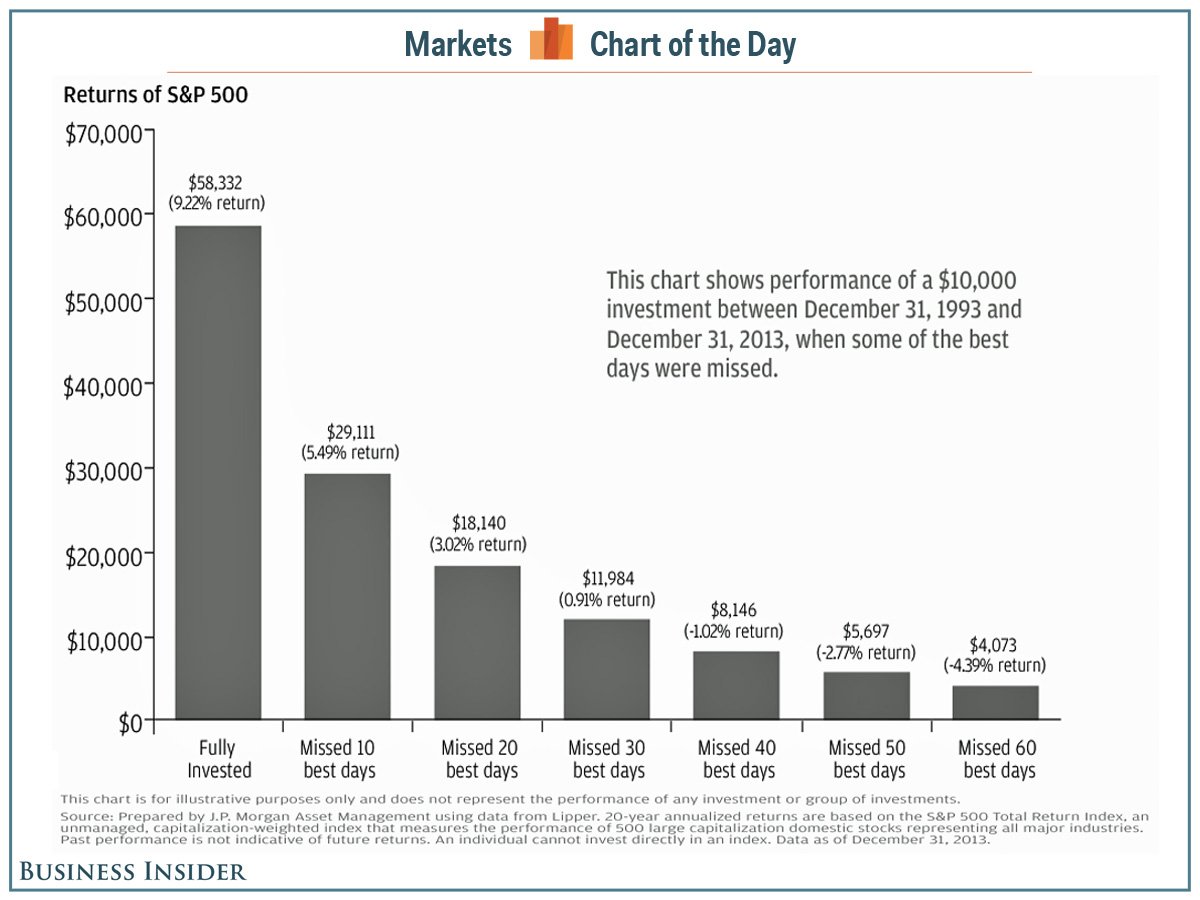
  • What you don’t want to do is invest in stocks, panic when it goes down and pull all your money out, then when the market goes back up move your money back in to stocks. That’s a losing game, and you will never get ahead that way. You are buying high and selling low, which is the opposite of what you should do. A lot of people do this, however, which is why there is a big difference between investment returns and investor returns. Investment returns assume you leave the money in the market, while investors move their money around when things get bad.This chart helps me to remember that I need to stay invested:

    missed opportunity

    This chart assumes you invested $10,000 between Dec 31, 1993 and Dec 31, 2013. During that time the stock market had some great years and rough years.If you kept it fully invested you would have ended up with just over $58,000. If you missed the 10 best days (which often come right after the worst days) your return drops to $29,000. If you missed the 40 best days your return is actually negative – your $10,000 drops to $8,147.

    People miss the best days all the time though because they switch from stocks to cash when the market goes down, miss the up-side, and invest when stocks are back at their most expensive.

I realize that all these charts and statistics don’t make you say, “Well, I’m sure glad my portfolio is losing money!” No one likes to see their portfolio drop for even a day, let alone for a few years in a row.

Every time it feels different, like we aren’t going to recover this time. I understand it. I get it. If you need help, find a financial planner who can help you set goals and stick to the strategy you outline together. Make sure it is someone you trust and has your best interests at heart. Someone who will teach you and encourage you and cheer you on.

As always, feel free to leave comments or ask questions below, on Facebook or in an e-mail.

Share this:
Facebooktwitterpinterestlinkedinmail