Why Giving Matters

by Ryan H. Law

Did you know there is one thing you can do that has been scientifically proven to:

  • lower your levels of stress
  • make you more productive and more successful, and
  • make you happier, healthier and more prosperous?

It’s a simple thing as well.

It’s giving.

Giving of your money, your time, or even giving blood.

Of course, most of us don’t give because of the benefits we gain, but because we genuinely want to help other people.

My post today mainly comes from Arthur C. Brooks’ work, who is one of the leading researchers on charitable giving in the United States.

Rockefeller2Brooks came across a statement from John D. Rockefeller where Rockefeller stated that he was rich because he gave so much, and he believed if he stopped giving that God would take his money away from him.

Rockefeller was very wealthy.

His net worth was about $340 billion, and during his lifetime he gave away about $540 million.

He came across statements from a number of other wealthy people who basically said the same thing.

This bothered Brooks so he set out to prove that Rockefeller and others were wrong. Brooks says, “…what I found was that Rockefeller was right and I was wrong [1].” You can read the article referenced below to get into the details of the studies that he did, but what I want to look at here is the results of his studies.

Here are some things that Brooks discovered:

  • Prosperity – when people give they prosper
    • This is true whether you are giving of your time, money or even giving blood.
    • If you take two identical families except that one family gives $100 more to charity than the other family, the giving family will earn on average $375 more in income than the non-giving family, and that $375 is statistically attributable to the $100 gift.
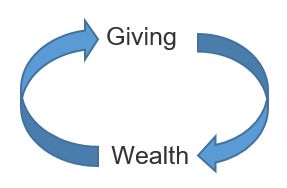
    • As people and our country gets richer, they give more away, but as we give more away it translates into better economic growth for the country and the individual – it’s a wonderful cycle – the more you give the wealthier you become, which allows you to give more, which leads to more prosperity and on and on.Giving cycle
  • Happiness & stress reduction
    • People who give are happier than those who do not give
      • People who give money are 43% more likely than people who don’t give to say they are very happy people.
      • People who give blood are twice as likely to say they are very happy people than those who don’t give blood.
    • When people give, it lowers their levels of stress which makes them more productive and more successful at work.
      • One study showed that those who gave cut their stress hormones in half.

Let me share a story with you that illustrates at least one aspect of this. When I was younger – probably about 10 years old, there was a big snowstorm that left a fair amount of snow in our neighborhood. There was an older widow who lived on the corner, and my older brother and I and a friend from across the street decided we would shovel her driveway, but we were going to do it quietly so she wouldn’t know who did it.

Well, you can imagine how quietly three boys that age can shovel a driveway, but we did try! Every time she would peek out her window we would throw our shovels down and dive behind a bank of snow, figuring we were so fast she wouldn’t be able to see us. I remember going home feeling tired from shoveling, but also feeling really happy. Happy that we had pulled off this great feat of both strength and stealth, but happier because we had done something for her that she wasn’t physically capable of doing for herself. To this day I still feel happy when I think about it. We were definitely the main beneficiaries of this.

cookiesWe did find out later that we weren’t quite as stealthy as we thought when she brought us some cookies, so not only did we get the benefit of feeling happy, but some nice warm cookies as well. =)

I’m sure you have similar experiences – perhaps you have volunteered at a Food Bank, or a homeless shelter, or coached a little league team or done countless other acts of service as so many Americans do, and you felt the same way I did – giving of your time makes you happier.

I find the same is true of money. The very first thing on our budget line is the 10% we give to our church [2]. We never miss this money. Giving doesn’t make you poorer.

Brooks says, “What I charge you with today is what I charge myself with, which is to discover more creative solutions to working these concepts into our everyday lives.” Remember that you are the main beneficiary of your giving – it will lower your levels of stress, make you more productive and more successful, and make you happier, healthier and more prosperous. Just like Brooks I encourage you and me to examine our giving to see where we can do better.


Who Really Cares[1] http://speeches.byu.edu/?act=viewitem&id=1826 Note: This speech was given at Brigham Young University in 2009. Brooks, a Roman Catholic, talks about Mormon giving in this article but also deals with giving in general. You can also read Brooks’ book: Who Really Cares (http://www.amazon.com/Who-Really-Cares-Compassionate-Conservatism-ebook/dp/B004VRP37S/ref=sr_1_1?ie=UTF8&qid=1396546413&sr=8-1&keywords=who+really+cares+brooks) which deals with the subject matter without getting into the specifics of Mormon giving. The article is a great synopsis of the book, though, regardless of your religious affiliation or non-affiliation.

[2] Brooks found that of those who practice a faith (attend church weekly), 91% give to charity each year, compared to 66% of those who don’t attend weekly. Practicing faith is the number one predictor of giving. Malachi, in the Bible, says essentially the same thing Brooks is saying: “Bring all the tithes into the storehouse, that there may be meat in mine house, and prove me now herewith, saith the Lord of hosts, if I will not open you the windows of heaven, and pour you out a blessing, that there shall not be room enough to receive it” (Malachi 3:8-10). Giving brings us a myriad of blessings, as Brooks has pointed out, but you certainly don’t have to be religious to give!

Share this:
Facebooktwitterpinterestlinkedinmail

3 day cooling off period

Our home still has the original windows in it with metal frames. It lets in a lot of heat in the summer, and a lot of cold in the winter. They are single-pane and incredibly inefficient, so we have been in the market for new windows.

We’ve had two door-to-door salespeople come by offering to do a quote. The first guy wanted 2.5 hours for the appointment, and never would give us an estimate until he looked at every window and pointed out all the problems (tip for that type of salesperson – we know we need all new windows, you don’t need to spend 10 minutes analyzing each one!). The second guy was really nice, but we fell for a marketing ploy. “We don’t do any type of advertising. In a 3-square mile area we pick two homes and you become our marketing home. We put a sign up in your yard for 60 days and direct people to look at your windows. For that, we give you a big discount.” He sold us on the virtuous of their 3-pane windows and lifetime warranty. (It turns out, by the way, that you don’t need 3-pane windows unless you live in a really cold or hot place.)

We needed new windows, so we decided to take the plunge and put 20% down and signed the contract. The windows would take about 8-weeks because they special order them for your home.

The salesman gave us a bunch of paperwork and we set it aside since this was just before Christmas. Christmas and New Years came and went and we started doing some research (well, asking friends on Facebook. That counts as research, right?). It turns out that those who had new windows put in paid about half of what we paid. We decided to get out of the contract. However, just above where we signed it said this:

“YOU, THE BUYER, MAY CANCEL THIS TRANSACTION BY DELIVERING WRITTEN NOTICE TO THE SELLER AT ANY TIME PRIOR TO MIDNIGHT OF THE THIRD BUSINESS DAY AFTER THE DATE OF THIS TRANSACTION.”

Oops….we were well past the third business day, but I figured I would contact the seller anyway since they hadn’t done any work yet and the windows hadn’t been ordered. I e-mailed the salesman and his regional manager and got an e-mail back basically saying, “Tough luck. You signed the contract and we’re going to make you stick to it.” We went back and forth – “do you really want your marketing home to be an unhappy customer? Let’s look at doing something different – maybe double-pane windows instead.” They basically said, “No, you are beyond the third business day. We’re holding you to it.”

I decided to do some actual research, though, to see if there was any way out of the contract. I first went to the Federal Trade Commission’s website and found an article about the FTC’s cooling off rule (http://www.consumer.ftc.gov/articles/0176-buyers-remorse-when-ftcs-cooling-rule-may-help). It basically says that as long as the sale was over $25 and not at the seller’s place of business the seller has to do three things:

1. The seller must tell you about your right to cancel at the time of sale
2. The seller also must give you two copies of a cancellation form (one to keep and one to send if you decide to cancel your purchase) and a copy of your contract or receipt
3. The contract or receipt should be dated, show the name and address of the seller, and explain your right to cancel

The seller had done two and three, but not the first one – he neglected to tell us about it. I sent the article to the regional manager and he said, “You are beyond the third day, but I’ll check with the company owner. You’re not getting out of this contract. We had a Utah lawyer write the contract and it complies with Utah law in all matters.”

While I was waiting for him, I did more research. I went to the Utah Division of Consumer Protection website (http://www.consumerprotection.utah.gov/) and it turns out that Utah law (http://www.rules.utah.gov/publicat/code/r152/r152-11.htm) states:

(a) The notice required shall:
(i) be a conspicuous statement written in dark bold with at least 12-point type on the first page of the purchase documentation; and
(ii) read as follows: “YOU, THE BUYER, MAY CANCEL THIS CONTRACT AT ANY TIME PRIOR TO MIDNIGHT OF THE THIRD BUSINESS DAY AFTER THE DATE OF THE TRANSACTION OR RECEIPT OF THE PRODUCT, WHICHEVER IS LATER.”

I had something here – their contract neglected the words “OR RECEIPT OF THE PRODUCT, WHICHEVER IS LATER.” I called an investigator with the Utah Division of Consumer Protection Services, explained the situation and asked if “receipt of the product” is a receipt like you get at a store or physical receipt of the product. She confirmed it is physical receipt of the product. She said the company was in violation of Utah law because their contract didn’t have that provision on it and that we were entitled to a full refund until the windows are installed. She also said that she was going to investigate the company to be sure they add that to their contract, and that if they didn’t promptly refund the money her office would take over and get it back.

I sent this all in an e-mail to the company and shortly thereafter got a phone call from the regional manager. “Of course it’s no problem. We’re going to let you out of your contract and as a thank-you for helping us realize we didn’t have the correct wording on there we’re willing to take $2,000 off double-pane windows if you would like to do that.”

We aren’t taking them up on the offer.

We learned some important things:

1. We’re putting up a no soliciting sign. I know this won’t stop all salespeople, but it will help. In general, door-to-door salespeople use high pressure tactics and count on you not being able to do any research. They will have slick advertisements and endorsements convincing you to take action now. Our sign will say that youth are welcome to knock. After all, we still want some Girl Scout cookies =)

2. It pays to do your research. If you are in Utah you have until the physical receipt of the product to cancel. If you live outside of Utah check your own state’s rules (if you find it for your state, please put it in the comments below).

3. Don’t sign a contract without reading it in full.

4. Do some comparison shopping before you sign a contract.

5. Don’t be pressured by “you get 15% off, but only if you sign today” or “we only need one more marketing home in your area.” They know that three days is too short to really do any comparison shopping, so they will try to pressure  you to buy that day. Inform them that you are going to comparison shop and you aren’t worried about not getting the best price from them today. If you decide to go with the company insist they give you the discount they were going to give you that day.

6. Talk to your friends – Facebook is a great start – about companies they used and if they liked or didn’t like them. We have since received several referrals for window companies and will likely go with one of them.

We almost had to learn a really expensive lesson, but we will be sure to follow all of these from this point forward.

Remember, if you find your state’s rules, please post them in the comments below.

Share this:
Facebooktwitterpinterestlinkedinmail

The Difference

For each attitude or behavior listed below indicate whether it describes you Very Well, Well, Slightly or Not at All.

Very Well Well Slightly Not at All
I feel stocks are worth the risk.
I devote money to personal savings each month.
I save regularly for emergencies.
I have invested for retirement.
I am significantly reducing or I have eliminated outstanding debt.
I have a goal to be financially comfortable during my working years.
I have a goal to retire comfortably.
I know what I want to do for a career and I am actively pursuing it.
I have a goal to accumulate $1 million.
I own a home (or plan to).
I am confident.
I am optimistic.
I am happy.
I am competitive.
I am a leader.
I have a college degree or I am actively working on getting one.
I socialize with friends at least once a week.
I exercise at least 2-3 times per week.
I read newspapers (or online news) regularly.
I am married (or plan to be married).

According to research conducted by Merrill Lynch, Harris Interactive and Jean Chatzky, these twenty attitudes and behaviors were the most critical in determining individuals varying levels of wealth.[1]

The initial question asked by Chatzky was, “Why do some people seem to move relatively easily from a paycheck-to-paycheck existence into comfort or wealth, while others get stuck or – worse – fall back?”

The study, which included hundreds of questions and was administered to more than five thousand individuals, identifies four levels of wealth, along with what percentage of the population falls into each category:

  • The wealthy – 3%
  • The financially comfortable – 27%
  • The paycheck-to-paycheck – 54%
  • The further-in-debtors – 15%

Chatzky and her team found that the wealthy can select at least twelve of the twenty attitudes and behaviors listed above as describing them “very well”, the financially comfortable have at least ten, while only half of those in the paycheck-to-paycheck group or further-in-debtors have more than three that describe them “very well”. In her book, The Difference, Chatzky stresses that most of the above factors are things that can be learned, and that moving up is not only possible, but inevitable if you focus on the right things.

There are, of course, other important factors. While these were identified as the top 20, Chatzky also discusses gratitude, giving, hard work, long-term thinking and others.

Here is Chatzky’s description of those who understand the difference their attitudes and behaviors make and have achieved success in life:

“They knew what they wanted, they plotted a course, and they arrived. They’re not stagnant. That wouldn’t do. Every day, they think about what’s next and set about achieving it with intention and purpose. And today, as a result, they are surrounded by people they care deeply about – and who return the favor. They wake up happy and go to sleep fulfilled. And they don’t lose sleep at night worrying about paying that next bill or any other financial matter.”[2]

It does take time, after developing the attitudes and behaviors listed above, to move from one group to the next. On average, it takes about seven to eight years to move from paycheck-to-paycheck to financially comfortable, and an additional eight to move to a life of wealth. In can be done faster – in fact there were some people that moved from paycheck-to-paycheck to wealth in a total of about ten years. The research also showed the number one reason people slipped from financial security to living paycheck-to-paycheck is overspending.

So where does all of this data leave us? First, Chatzky says, is that you need to make a decision that you want to change and achieve higher levels of wealth. “You choose The Difference,” Chatzky says, “it does not choose you.” Second, you have to take action. Look through the list above and select some things you can begin to work on. Maybe you can start building up your emergency fund, or start exercising more, or focus on your career goals. Any step in the right direction is a good step to take.

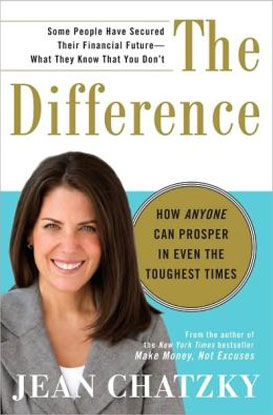
For further discussion on this topic, I encourage you to read Jean Chatzky’s book The Difference.

Ryan H. Law, M.S., CFP®, AFC®

[1] The study and findings are discussed in detail in Jean Chatzky’s book “The Difference”  ISBN: 978-0-307-40714-6
[2] Chatzky The Difference pp. 2


For a printable version of this article go to: www.ryanhlaw.com/The_Difference.pdf


      Meeting Jean Chatzky at a conference

Share this:
Facebooktwitterpinterestlinkedinmail